
Crate Sizing Chart
A crate should be big enough for your dog to stand up, turn around and lie down comfortably — but not so big that it stops feeling like a cosy den. Enter your dog’s length and height and the calculator adds the recommended room, then matches it to standard crate sizes. It also estimates the size a puppy will need as an adult so you can buy once and use a divider.
- Free to use
- No sign-up
- Runs in your browser
Dog crate size calculator
Dog Crate Training Kit
Printable crate training kit: measuring guide and size chart, a 14-day crate training plan, a puppy toilet and crate schedule, and a crate time log.
- Size chart (PDF)
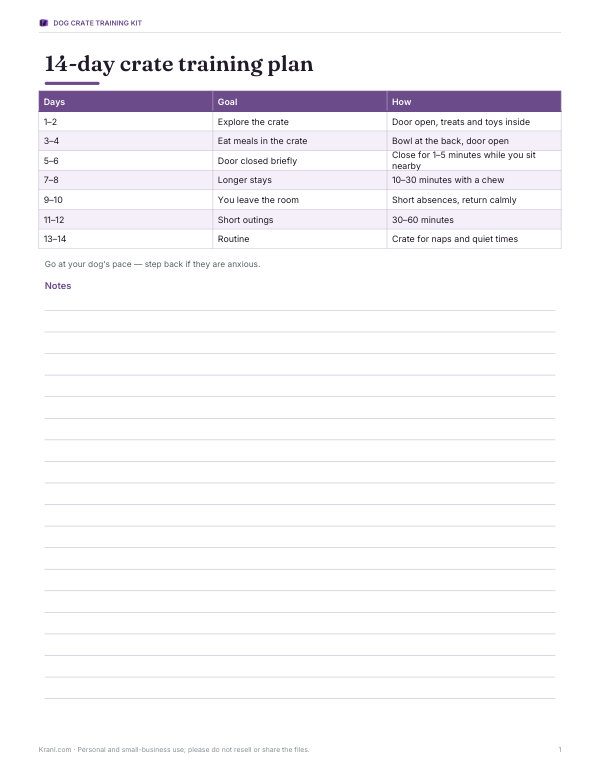
- 14-day plan (PDF/DOCX)
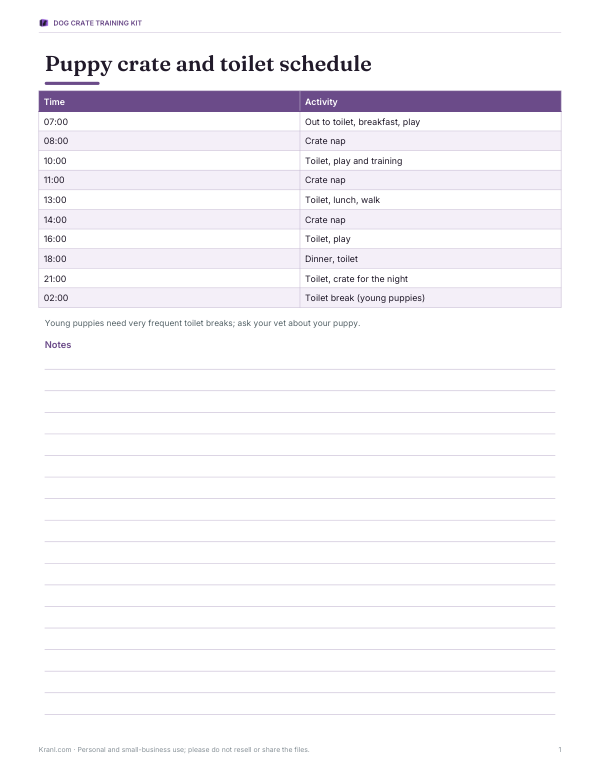
- Puppy schedule (PDF)
- Crate log (PDF, XLSX)
Formats: PDF, XLSX, DOCX. Instant download after payment (link valid 72 hours, up to 5 downloads). AI-assisted: the templates were drafted with AI help and reviewed and laid out before publishing.
$5.00 USD, one-time 4 files · about $1.25 each
- Instant download
- 7-day refund
- Secure checkout by Stripe
7-day money-back guarantee. Full refund within 7 days of purchase, even after you download.
Free sample: Crate Size Chart (PDF, 72 KB)
Full refund within 7 days — see the refund policy and license.
Free printables
Single sheets you can print right now, no sign-up. The full pack adds every sheet in one download plus the editable files.
 Printable Crate Log Sheet
How to measure your dog for a crate
- Length: with your dog standing, measure from the tip of the nose to the base of the tail (not the tip).
- Height: measure from the floor to the top of the head or ears, whichever is higher, with your dog sitting upright — many dogs are taller sitting than standing.
- Add about 2–4 inches (5–10 cm) to both measurements so your dog can stand, turn and stretch out.
- Compare with the crate’s interior dimensions, not the outside.
A helper and a treat make measuring much easier. Use a soft tape measure and a flat surface.
Standard dog crate sizes
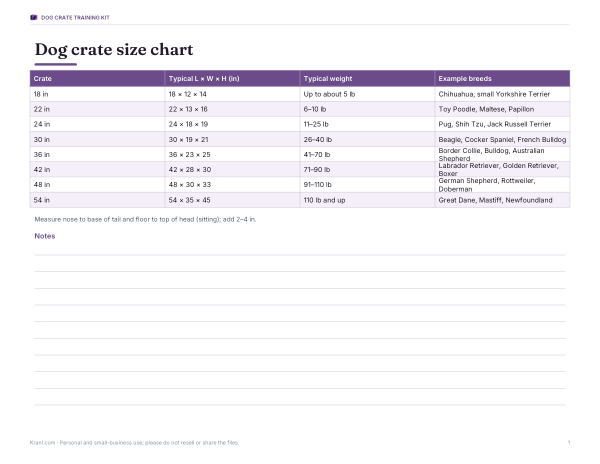
| Crate size | Typical L × W × H (in) | Typical weight | Example breeds |
|---|---|---|---|
| 18 in | 18 × 12 × 14 | Up to about 5 lb | Chihuahua, small Yorkshire Terrier |
| 22 in | 22 × 13 × 16 | 6–10 lb | Toy Poodle, Maltese, Papillon |
| 24 in | 24 × 18 × 19 | 11–25 lb | Pug, Shih Tzu, Jack Russell Terrier |
| 30 in | 30 × 19 × 21 | 26–40 lb | Beagle, Cocker Spaniel, French Bulldog |
| 36 in | 36 × 23 × 25 | 41–70 lb | Border Collie, Bulldog, Australian Shepherd |
| 42 in | 42 × 28 × 30 | 71–90 lb | Labrador Retriever, Golden Retriever, Boxer |
| 48 in | 48 × 30 × 33 | 91–110 lb | German Shepherd, Rottweiler, Doberman |
| 54 in | 54 × 35 × 45 | 110 lb and up | Great Dane, Mastiff, Newfoundland |
Sizes are named by length. Dimensions are typical of wire crates and vary between brands; plastic travel kennels use different size codes. Weight ranges and breeds are only a rough guide — measure your own dog, because build varies a lot within a breed.
Worked example
A 60 lb Border Collie cross measures 28 inches from nose to base of tail and 24 inches from floor to top of head when sitting. Adding 4 inches of room gives a minimum interior of 32 × 28 inches in length and height. A 36-inch crate is typically 36 × 23 × 25 inches — long enough but not tall enough — so the calculator suggests a 42-inch crate (about 42 × 28 × 30 in), which fits both. For a dog that is tall when sitting, height is often the deciding measurement.
Crate sizing for puppies
Puppies grow fast, and buying a new crate every few months is expensive. Many owners buy a crate for the expected adult size and use a divider panel to shorten the space. This matters for house training: dogs naturally avoid soiling where they sleep, but a crate that is much bigger than the puppy leaves room for a toilet corner. Move the divider back as the puppy grows. Ask your vet or breeder about expected adult size, especially for mixed breeds.
Choosing a crate type
| Type | Pros | Cons |
|---|---|---|
| Wire | Good airflow and visibility, folds flat, often includes a divider | Less den-like; cover with a blanket if your dog prefers |
| Plastic kennel | Cosy, enclosed; many are accepted for air travel | Less airflow; bulky to store |
| Soft-sided | Light and portable for travel | Not for chewers or escape artists |
| Heavy-duty metal | For strong dogs and determined escapers | Heavy and expensive |
| Furniture-style | Looks like an end table | Often less ventilation; check the interior size |
Making the crate a good place
- Introduce the crate gradually with treats and meals inside, door open at first.
- Add a washable bed or mat and a safe chew toy.
- Never use the crate as punishment.
- Keep crate time reasonable — adult dogs need regular exercise, company and toilet breaks; puppies need very frequent breaks.
- Remove collars with tags that could catch on wire.
- Place the crate somewhere quiet but not isolated, away from direct heat.
Signs a crate is the wrong size
- Your dog has to crouch or lower its head when standing.
- It can’t turn around without bumping the sides.
- It lies curled up tightly and can’t stretch out on its side.
- A puppy regularly soils one end of a large crate — the space is too big.
- Wire marks or rubbed fur on the head or back.
Cats and small pets
Cat carriers are sized in a similar way: the cat should be able to stand, turn around and lie down. For most adult cats a carrier about 18–24 inches long works; a top-opening carrier makes vet visits easier. Rabbits and guinea pigs need much larger living enclosures than travel carriers — the travel size is only for short trips.
Air travel
Airlines have their own rules for pet containers, based on the dog’s measurements and often following International Air Transport Association (IATA) guidance: typically the dog must be able to stand without its head touching the top, turn around and lie down naturally. Check your airline’s requirements well before travel, as they may be stricter than a home crate.
Privacy
The calculator runs in your browser; your measurements aren’t stored or sent.
Frequently asked questions
What size crate does my dog need?
Interior length and height about 2–4 inches more than your dog’s length (nose to base of tail) and height (sitting).
How do I measure my dog for a crate?
Measure nose to base of tail, and floor to top of head while sitting.
What size crate for a Labrador?
Often a 42-inch crate, but measure your dog.
Can a crate be too big?
Yes, especially for puppies — use a divider.
Are crate sizes the same for all brands?
No, compare interior dimensions.
What size crate for a German Shepherd?
Commonly a 48-inch crate.
Should I measure my dog sitting or standing for crate height?
Measure both and use the taller one — many dogs are taller when sitting.